
Citerion exists because search broke.
Not gradually. In a year. The search bar became a chat box. Ten blue links became three citations. And the playbook every marketing team had spent a decade building stopped working.
We built Citerion for the teams watching it happen live.




One quarter. A meaningful share of the traffic. Gone to ChatGPT.
This isn't theoretical. It's the moment Citerion was built.
A category-leading B2B SaaS client watched their organic traffic drop in a single quarter — rankings unchanged, domain authority unchanged, pages still ranked #1 on Google.
The traffic just stopped showing up.
The reason was simple, once we looked: their buyers had moved. They were asking ChatGPT, Perplexity, and Claude the same questions they used to type into Google. The AI engines were answering. The AI engines weren't citing the client.
There was no tool to see this clearly. No framework to diagnose it. No playbook to fix it.
So we built one.
The search bar moved.
It's a chat box now. The rules changed completely.
- 01The interface is conversational, not transactional.
- 02Answers cite 3–7 sources. Not ten blue links.
- 03AI engines pick which sources make the cut.
- 04If you're not in the citation set, you don't exist.
Two gaps in the AEO market.
A handful of tools showed up to track AI visibility. They all stopped at the same place.
Every tool surfaced raw data. None explained the underlying forces. You'd see your score drop and have no idea why.
You'd publish a fix, re-check manually, hope the score moved. No system tied content investment back to AI lift.
Citerion was built to close both.
One closed loop. One framework underneath.
The product runs the Citation Ecosystem Model on top of every major AI engine, end to end.
Four pillars. One ecosystem.
Every AI answer is built from a citation set. The Citation Ecosystem Model maps the four forces that decide whose content makes the cut.
The sources AI engines trust in your category. If they don't cite you, they cite someone else.
The questions your buyers actually ask. Every gap in your content is a competitor's opening.
AI engines reward current information. Stale pages quietly disappear from the citation set.
Your messaging across the open web. When sources contradict each other, AI picks the safer one. Usually not yours.
Every recommendation Citerion gives you traces back to one of these four.
The audit, end to end.
Every Citerion audit produces:
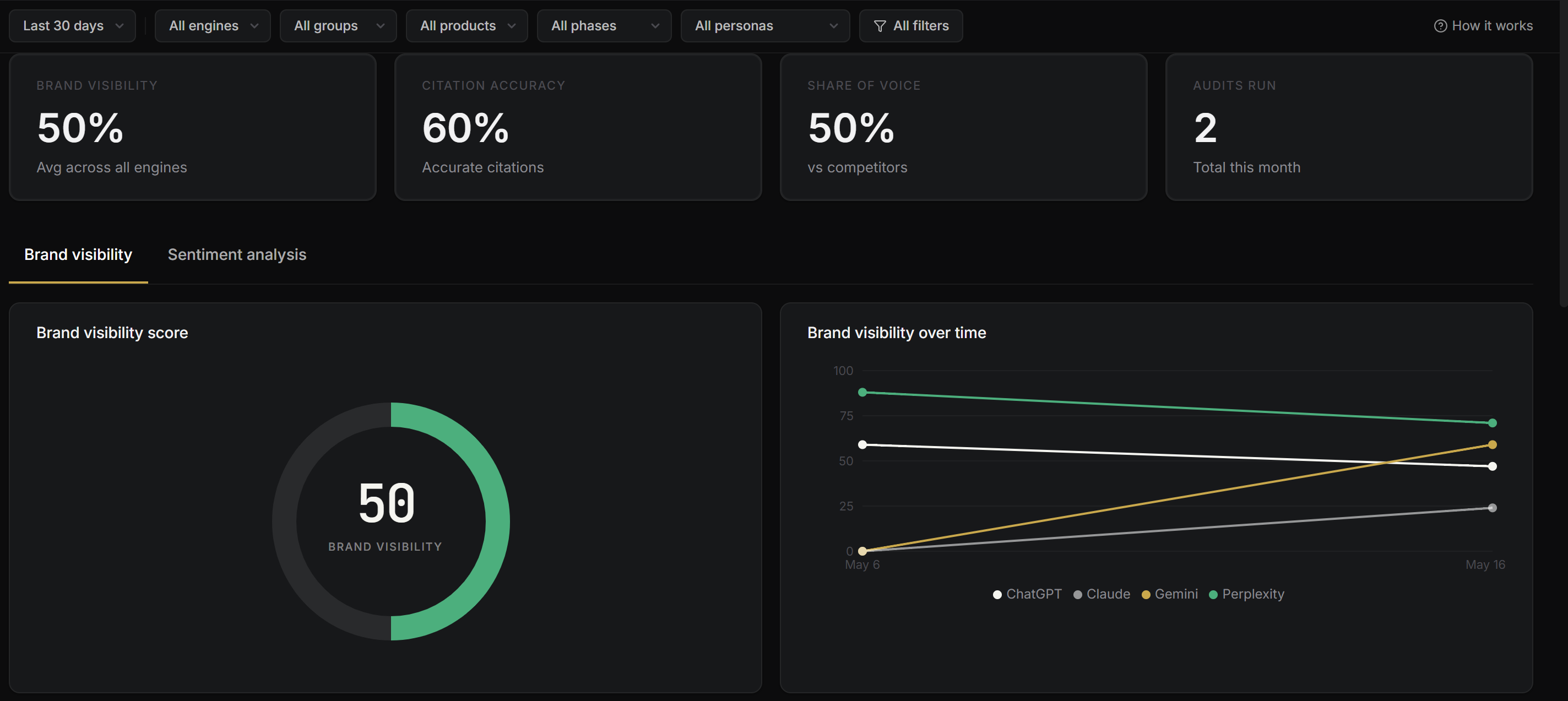
How often you're cited across all four engines and all prompts.
Where you stand on ChatGPT, Claude, Perplexity, and Gemini individually.
Exactly which buyer questions cite you, cite a competitor, or cite no one.
Every URL behind every answer.
A prioritized list of fixes, with content briefs, mapped to the four pillars.
Citations worth scrutinizing where what AI says about you may need correction.
One framework. One closed loop. One product.
Two things no one else in AEO is doing.
Most tools sell a dashboard. Citerion sells a methodology — the Citation Ecosystem Model — that other AEO tools will eventually copy.
Not by a team chasing a category. Citerion was built by an SEO operator who watched AI traffic eat client rankings — and built the tool that should have existed.
See where AI puts your brand.
Run a free audit across ChatGPT, Claude, Perplexity, and Gemini. Get the report in about 90 seconds.